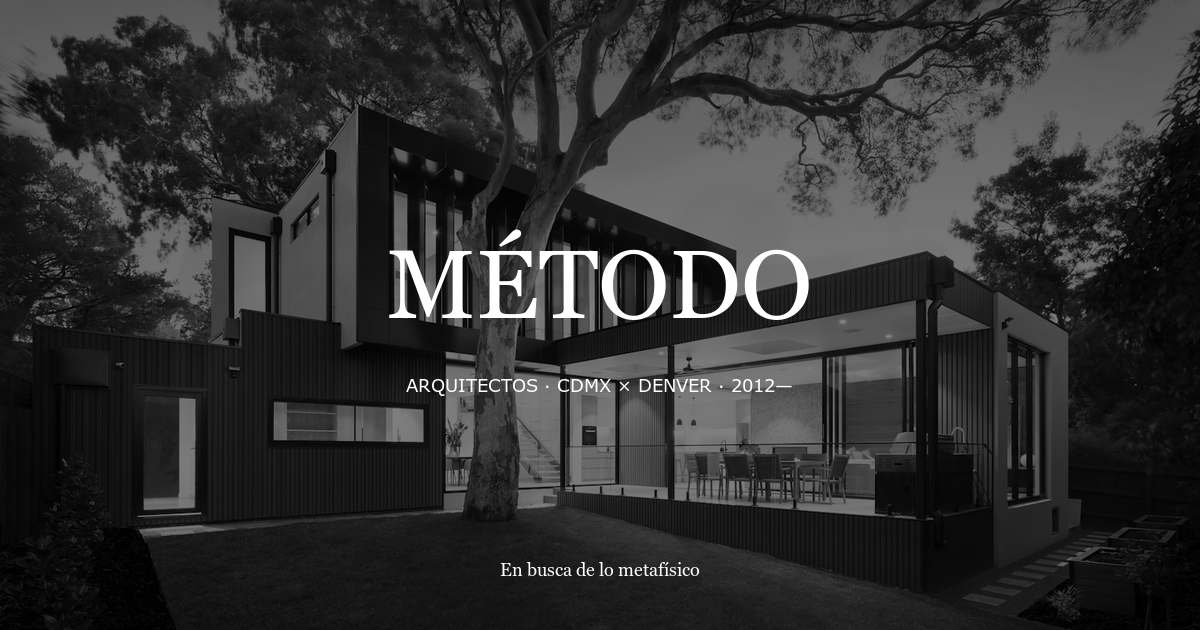
The aesthetic of a courtyard water feature is the result of spatial and material decisions, not the starting point for them. When a water feature looks right, it is because its geometry, proportion, and material are in direct conversation with the courtyard that contains it.
In MÉTODO, we do not select water features from a catalog. We design them as elements of the courtyard architecture. The process antes que el estilo.
Water as a Spatial Material
Water in a courtyard does something no other material does: it changes quality through the day, through the season, and in response to environmental conditions — light angle, wind, temperature.
A still basin in the morning light reflects the sky and the walls that bound it. At midday, direct sun creates a white glare on the water surface and casts wave patterns on adjacent walls. In the afternoon, the angle of light makes the reflected pattern move across the ceiling of the shade structure. At night, with a single submerged light source, the basin becomes a luminous element.
These are not decorative effects. They are the spatial contribution of a correctly designed water element. The architect's job is to position and proportion the basin so that these effects work for the space — not against it, not randomly.
The Geometry of the Basin Relative to the Courtyard
A water basin in a courtyard has a geometric relationship with the space that surrounds it. The edges of the basin relate to the walls. The water surface height relates to the floor level and to the eye level of someone seated nearby.
Three relationships that determine the aesthetic:
Flush edge vs. raised edge: a basin with a flush stone or concrete lip that overflows at the rim creates a mirror — the water surface is visually continuous with the floor plane. A raised-edge basin reads as a container, a bowl. The flush edge is more spatially demanding because the overflow system must be perfectly level; the raised edge is more forgiving but heavier visually.
Basin proportion relative to courtyard: a basin that is too small in a large courtyard disappears. A basin that is too large dominates and reduces the sense of space. As a proportion, the water surface area of a central basin typically works between 10 and 20 percent of the total courtyard floor area.
Water surface height relative to seated eye level: when the water surface is at or near the eye level of someone seated at its edge, the reflected sky becomes a significant part of the experience. When the basin is below walking floor level, the reflection reads from standing position. The section determines which experience the design is targeting.
Sound as an Intentional Design Choice
The sound of a water feature is a spatial element. In a small enclosed courtyard — 20 to 40 square meters — a turbulent fountain produces sound that fills the entire space. Some clients find this pleasant; others find it exhausting. A cascading feature in a small courtyard can make conversation difficult.
The alternative for enclosed spaces: a slow weir, a thin overflow sheet, or a still basin with minimal circulation. These produce minimal sound. The courtyard remains quiet, and the water functions visually rather than acoustically.
For a larger terrace or a more open courtyard, the sound of moving water masks urban noise — traffic, voices from the street — and improves the acoustic comfort of the outdoor space. Here, a more turbulent feature is appropriate.
We discuss sound explicitly in the program phase. It is a design parameter with functional consequences.
Materialidad Honesta in the Basin
The water basin material is not separate from the courtyard material palette. Materialidad honesta means the basin is made from the same family of materials as the space that holds it — not from a contrasting showpiece material.
In a concrete courtyard: a cast concrete basin, possibly with a textured interior or an applied pigment. In a stone courtyard: a stone basin cut from the same family of stone as the floor and walls. In a courtyard with a mixed palette: the basin material is the one that grounds the space — typically the heaviest, densest material in the palette.
A contrasting basin — a stainless steel vessel in a stone courtyard, or a ceramic bowl in a concrete space — calls attention to itself rather than contributing to the whole. The aesthetic of the courtyard is served by coherence, not contrast.
Próximos pasos
A water feature with intentional aesthetics is the product of spatial design, material logic, and sound decisions made before any product is selected. To understand how we approach courtyard water feature design as part of the architectural project, conoce el método de MÉTODO.