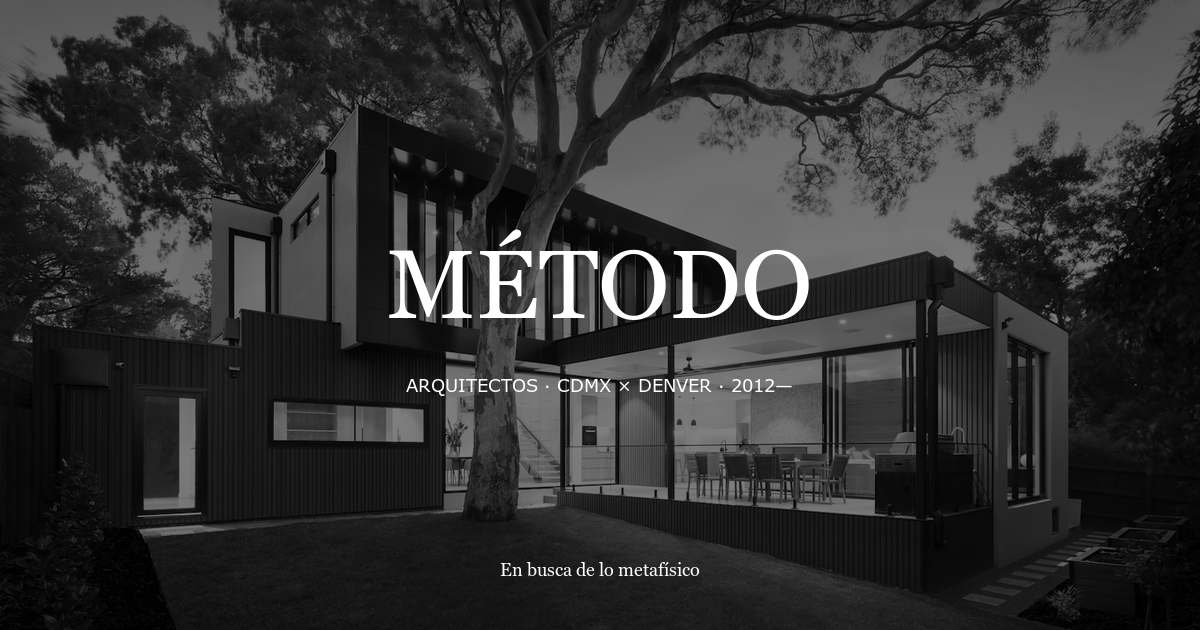
A 260-square-meter house is not a reduced version of a larger one. It is a distinct brief with its own spatial logic — one that rewards clarity and penalizes indecision. In MÉTODO, we treat compact residential design as one of the most demanding exercises in the discipline: every square meter must justify its existence.
The Constraint as Design Generator
Urban lots in Mexico City come with real restrictions: floor-to-area ratios, required setbacks, height limits, and party-wall conditions on two or three sides. A 260-square-meter house on an 8-by-20-meter lot has perhaps 160 square meters of buildable footprint per floor, depending on zoning. That constraint is not a problem to solve around — it is the starting condition.
We begin with what we call a matriz de opciones: two or three spatial organizations tested against the same program and site, compared with the client before committing. The comparison reveals trade-offs that a single proposal cannot show. Do you want a double-height living room and smaller bedrooms, or a generous bedroom floor and a single-height social level? Both fit in 260 square meters. They produce different houses.
The Section as the Real Design Document
In a compact plan, the plan drawing tells only part of the story. The section — the vertical cut through the building — is where the house is actually designed. Height differentials between spaces, double volumes above specific rooms, light entry from clerestories, and the relationship between ground level and the street are all resolved in section.
La sección como relato: the section as narrative. A stair that opens onto a double-height space at the landing, a bedroom that sits half a level above the garden, a kitchen connected visually to a mezzanine — these spatial events cost nothing in area but transform the experience of the house.
We draw sections early and iterate them alongside the plan. The two documents are in constant conversation.
The Patio as Organizer in 260 Sqm
Even in a compact house, we look for the opportunity to introduce a small interior courtyard. A patio as organizer does not need to be large. At 12 to 16 square meters, it provides:
- Natural light to rooms that would otherwise rely on the street facade or party walls
- Cross-ventilation that reduces reliance on mechanical cooling
- A visual terminus that prevents interior rooms from feeling enclosed
The patio is not a luxury feature added when budget allows. It is a structural decision about how light and air reach the interior — resolved in the first schematic, not added later.
Material Honesty at Compact Scale
In a house of this scale, material quality is more perceptible, not less. There is no large volume to absorb inconsistency. Every surface is close.
Stone, wood, and concrete — materials that age with dignity — perform particularly well in compact residential projects because they do not require frequent replacement or maintenance finishes. A polished concrete floor in a compact living area telegraphs the same quality at 40 square meters as it does at 80. A wood ceiling in a bedroom occupies the same visual field regardless of room size.
We specify materials that earn their cost over time, not ones that photograph well at handover and fade by the third year.
Program Efficiency Without Reduction
260 square meters can accommodate a full residential program without reducing any space to token presence. The discipline lies in eliminating what does not earn its place:
- Corridors that serve only as corridors are replaced by transition spaces with secondary uses
- The laundry-service zone is integrated into the kitchen sequence, not isolated behind a door
- Guest rooms double as study or library when not in use
None of this requires unusual construction or special technology. It requires decisions made early, in the schematic phase, before the program hardens into habit.
Próximos pasos
A compact house is not a simplified project — it is a precise one. The conversations that produce a clear, well-organized residence at 260 square meters are the same conversations that produce any good house. They begin with the program, the section, and the site.
Conoce el método de MÉTODO to understand how we approach residential design at any scale.