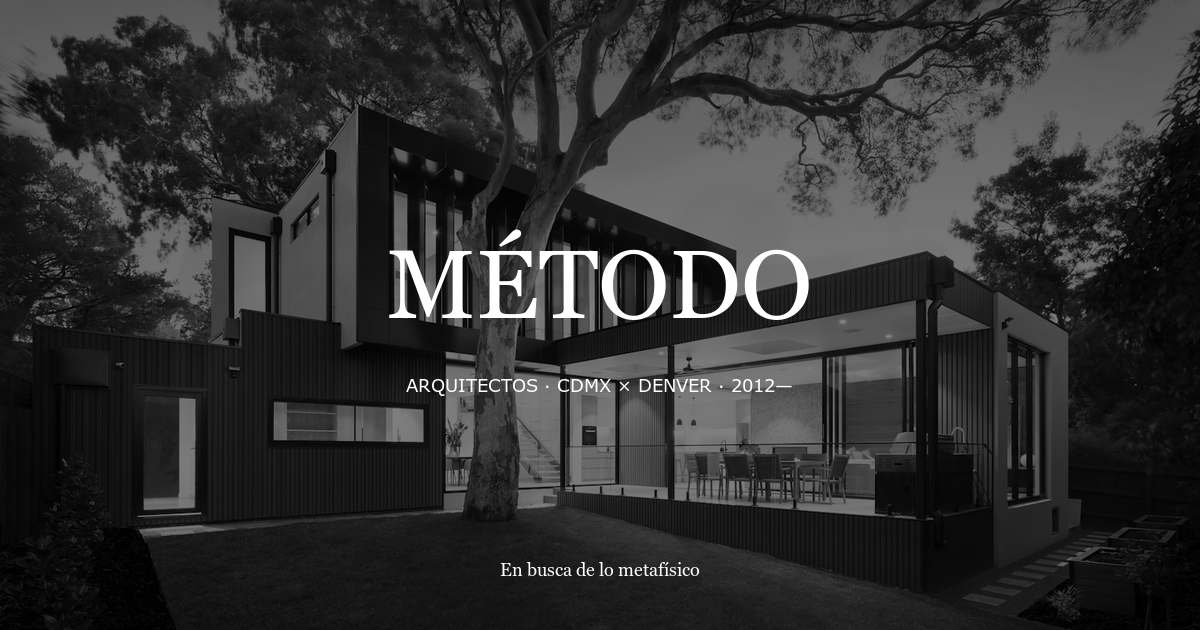
Custom wood furniture in an architectural home in Denver is not a decorative decision made after construction. It is an extension of the architecture — same material discipline, same proportional logic, same attention to how wood behaves in Colorado's specific climate. When furniture and architecture are designed from the same set of decisions, the room reads as a coherent object. When they are specified separately, the result is a well-built house with furniture that happens to fit inside it.
In MÉTODO, furniture specification begins during design development, not at move-in.
Denver's Climate and Wood Behavior
Denver's climate is semi-arid: average annual relative humidity of 40 to 50%, dropping to 20 to 30% in winter when heating systems run. This low humidity causes wood to lose moisture and shrink. Furniture pieces with large solid wood panels — dining tables, cabinet doors, headboards — must be designed and jointed to accommodate seasonal movement.
Wood species that perform well in Denver's humidity range:
- Walnut (American black walnut): moderate shrinkage coefficients, stable under finish, warm brown tone with visible grain — one of the most reliable species for large panel applications in dry climates
- White oak: slightly higher shrinkage but excellent workability and a fine, consistent ray-fleck pattern that reads well under Colorado's clear directional light
- Hard maple: dense, fine-grained, light in color — takes paint, stain, or natural finish with equal quality
- Douglas fir (regional Colorado): soft species but available locally, takes carving and profile work, appropriate for furniture in more casual or textural contexts
Species to avoid in Denver dry conditions:
- Teak and other tropical hardwoods with high natural oil content — perform well in humidity but can leach oil deposits in dry heat and move unpredictably with humidity cycling
- Cherry and mahogany — beautiful species but higher shrinkage coefficients; suitable for smaller pieces but problematic for large panels without precise joinery
Joinery That Accommodates Movement
The joint is the technical test of furniture quality. In a dry climate, a solid wood panel that cannot expand and contract seasonally will split, bow, or push its joints apart within a few years.
Joinery strategies for large panels in Denver:
- Floating panel construction: solid wood panels set in a groove within a mortise-and-tenon frame, allowing movement within the frame without stressing the joint
- Breadboard ends: on dining tables, end boards applied perpendicular to the main panel are elongated slot-screwed to allow the main panel to move without pulling the end board out of position
- Quartersawn wood for panel stock: quartersawn orientation cuts the log so annual rings run approximately perpendicular to the face, dramatically reducing seasonal width movement (quartersawn movement is roughly half that of flat-sawn material)
These are not premium upgrades — they are basic competencies for furniture made to last in Denver's climate. A piece built without movement accommodation will fail visibly within three years.
The Proportional Conversation Between Furniture and Architecture
Architectural furniture — custom pieces designed for a specific space — should not compete with the architecture for visual attention. The proportion, height, and profile of furniture should reinforce the spatial logic of the room, not contradict it.
In a room with 3 m ceilings and stone walls, a dining table at standard height (76 cm) with heavy tapered legs reads correctly. In the same room with 2.7 m ceilings and wood paneling, a lighter table with slender legs and lower visual mass creates less compression. The furniture height is the same; the visual relationship to the room changes.
In MÉTODO, we resolve this through a furniture-architecture section — the same section drawing used for daylighting analysis also shows the furniture silhouettes in proportion to the wall height, ceiling height, and window opening. This confirms whether the furniture scale reinforces or fights the room before fabrication begins.
Species Coordination with Wall Materials
The most common specification error in custom wood furniture for architectural homes is selecting furniture species without reference to the wall and floor materials already specified.
A dining room with walnut-stained white oak floors and a stone feature wall should not have walnut furniture — the tonal similarity between floor and table creates a monochromatic reading that loses depth. A dining table in white oak (matching the floor species but in natural finish against the stained floor) creates a deliberate dialogue. An alternative: a table in a pale solid species — maple, ash, or bleached walnut — against the dark floors creates maximum contrast.
Stone walls create specific species pairing logic. Rough-split grey basalt needs warm wood tones (walnut, aged oak) to prevent the room from reading cold. Polished limestone with pale grey tones pairs well with lighter wood species that don't compete with the stone's pattern.
These are coordination decisions that require the architect, the furniture maker, and the stone specification to be in dialogue during the selection process — not resolved independently and assembled at move-in.
Próximos pasos
Custom wood furniture for an architectural home in Denver requires lead time, climate-specific species selection, and coordination with the architecture during design development. The earlier this process begins, the more coherent the final result.
Conoce el método de MÉTODO to understand how we integrate furniture specification into our authored residential process in Denver and Mexico City.