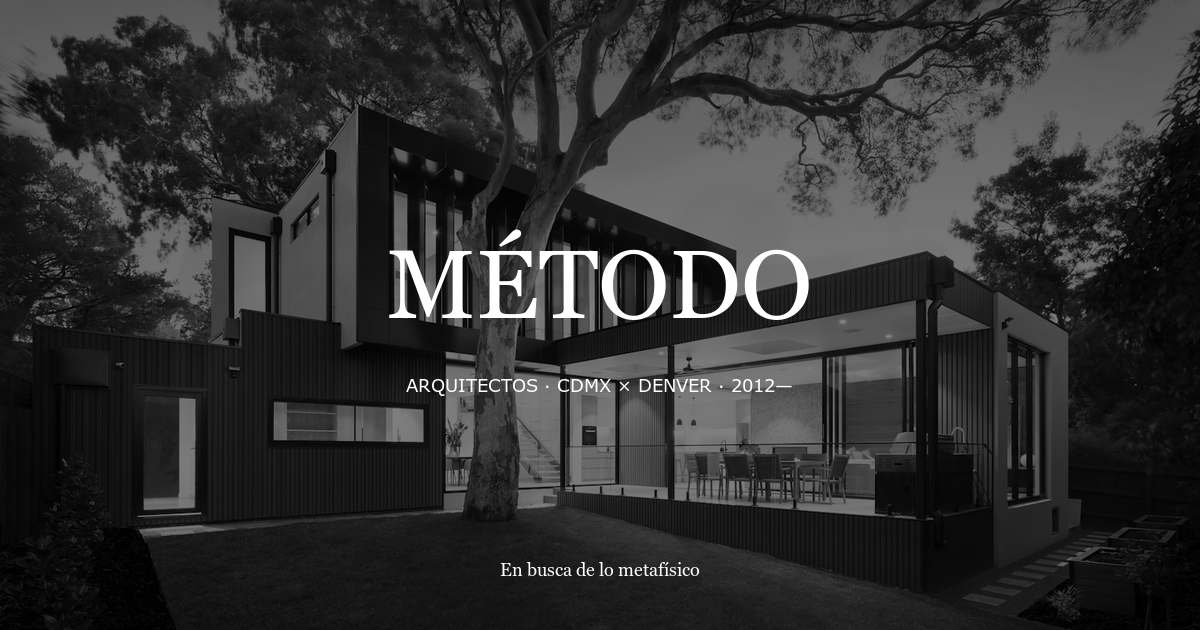
A custom concrete and wood interior is not a material trend. It is a material argument: two fundamentally different substances placed in deliberate contrast, each made more specific by the presence of the other. At MÉTODO, the logic of this pairing begins with the section, not with a mood board.
Why the Material Contrast Works
Concrete is formed, not grown. It is cast in place and fixed — it does not move, it does not breathe, and it does not soften. Wood is grown, not formed. It moves with humidity, responds to temperature, shows its growth rings in every cross-section.
When these two materials share a room, each makes the other more visible. The warmth of white oak grain reads more strongly against a smooth concrete wall than it would against painted drywall. The thermal mass and density of a polished concrete floor reads more decisively when a wood ceiling defines the space above it.
This is not aesthetic preference. It is a visual logic that arises from material contrast — from the principle that piedra, madera y concreto are materials that age with dignity, each in its own way.
Assigning Materials in the Section
The section is where we decide which surfaces carry concrete and which carry wood. The decision is based on three factors:
Visual weight hierarchy: Concrete's visual weight is higher than wood's. In most rooms, placing concrete at the base plane (floor) and wood at the upper plane (ceiling or cabinetry) creates a stable visual hierarchy — heavy at bottom, lighter above. Inverting this creates tension appropriate in some contexts and disorienting in others.
Thermal behavior: In Mexico, concrete floors and walls store daytime heat and release it at night — passive thermal regulation. In Colorado, concrete floors over radiant heating conduct and diffuse warmth efficiently. Wood at ceiling and wall planes provides the insulating and moisture-regulating properties that concrete lacks.
Touch hierarchy: Surfaces at hand height or below are touched. Concrete walls at hand height feel cold and slightly rough — this is appropriate in some spatial moments (a corridor, a bathroom, a kitchen backsplash) and wrong in others (a bedroom, a reading alcove). Wood at touch height is warm and slightly yielding — it communicates domesticity.
Transition Details: Where Concrete Meets Wood
The quality of a concrete-wood interior is most visible at the transitions — where one material ends and the other begins. There are three transition strategies we use:
Expressed gap: A deliberate open joint between concrete and wood, typically 1/4 to 1/2 inch, backed with a reveal that casts a shadow. This makes the transition explicit — each material ends where it ends, and the gap is the honest acknowledgment of two different things meeting.
Metal transition strip: A thin metal bar in blackened steel or bronze separates concrete from wood at floor-to-wall transitions or countertop edges. The metal is a third material that mediates the transition without pretending the two materials blend.
Overlap: Wood millwork overlaps onto a concrete wall with a defined reveal. The overlap implies that the concrete is primary and the wood is placed against it — a hierarchical relationship that reads as architecturally confident.
We never fill the transition between concrete and wood with caulk color-matched to one material or the other. The caulk joint is a field decision without design intent. We avoid it.
Surface Finish Coordination
The finish of each material affects how the pair reads in a room. A rough-textured concrete wall paired with a highly polished wood floor creates a visual dissonance between the two material registers. A honed concrete floor paired with a matte-oiled wood ceiling is in the same surface register — both reveal their texture without competing.
Our default pairing approach:
- Concrete surfaces: honed or burnished, matte to satin sheen
- Wood surfaces: penetrating oil finish, matte to satin
- Metal elements: matte or brushed finish, no high polish
High-gloss finishes on either material break the material dignity of the combination.
Próximos pasos
A concrete and wood interior done with care reads as composed and specific to its place. Done without a clear logic of where each material belongs, it reads as stylistic indecision.
Conoce el método de MÉTODO and understand how we resolve material decisions from the section out — before a single finish is specified.