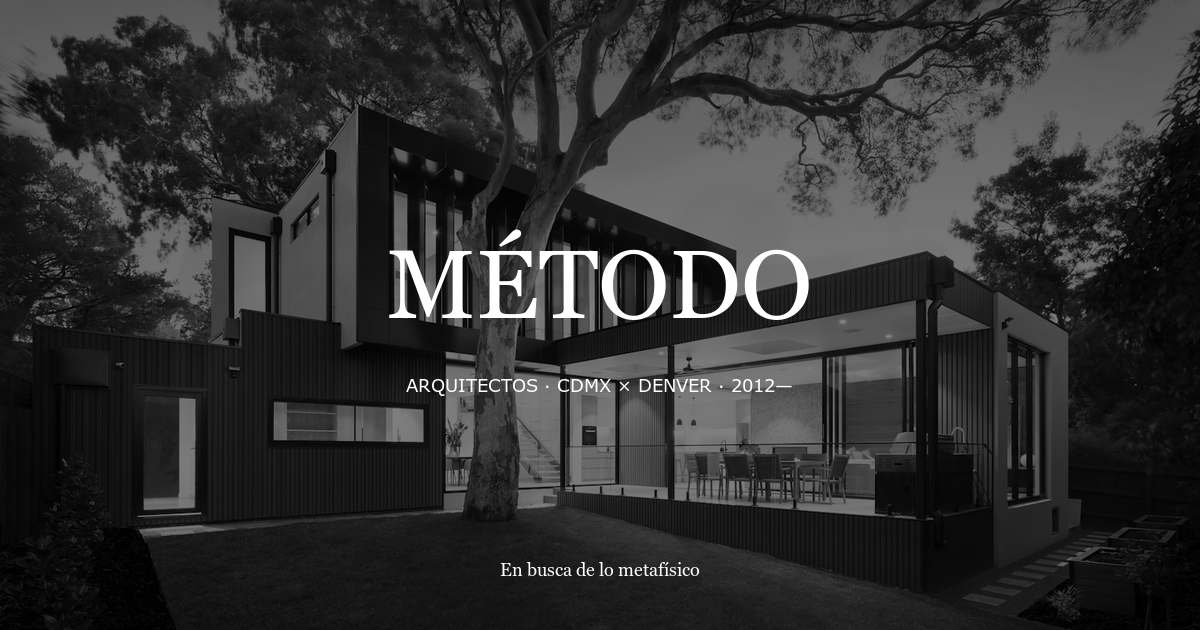
Boulder County's residential design context is defined by altitude, views, fire risk, and a regulatory environment that requires specific attention. Contemporary concrete is a rational response to several of these conditions simultaneously — it is non-combustible, thermally massive, structurally capable on sloped sites, and durable at the freeze-thaw cycling rates of 1,600 to 3,500 m elevation.
In MÉTODO, we design contemporary concrete residences in Boulder County as site-specific responses to these conditions, not as a style applied to a generic lot.
Boulder County's Site Conditions: What Concrete Addresses
Wildfire interface. Boulder County has significant Wildland-Urban Interface (WUI) areas, particularly in the foothills west of Boulder, Nederland, and Lyons. The Marshall Fire of 2021 expanded awareness of fire risk in areas previously considered lower risk. Boulder County's WUI code now requires specific ignition-resistant construction for many residential sites.
Concrete is non-combustible and satisfies the most stringent ignition-resistant construction requirements without additional cladding or treatment. For a client building in a designated WUI area, concrete exterior walls eliminate the upgrade cost that wood-frame construction with fire-rated cladding would require.
Grade and topography. Boulder County's foothills terrain ranges from gently rolling at the plains edge to dramatically sloped in the mountain communities. Concrete construction on sloped sites enables split-level sections and below-grade rooms that follow the topography rather than fighting it. Retaining structures in concrete are both structural and visible — they become the site walls, the landscape elements, and the foundation all at once.
Altitude range. From central Boulder (1,655 m) to Nederland (2,580 m) to mountain community sites above 3,000 m, the altitude range in Boulder County spans conditions that require different concrete specifications. Mountain community projects require more aggressive air entrainment, closer attention to cold-weather curing, and penetrating sealers appropriate for high UV exposure.
Seismic and wind. Boulder County sits in a moderate seismic zone and is exposed to significant Front Range wind events. Concrete shear walls provide lateral resistance for both seismic and wind loads in a single structural system.
Section Design for Boulder County Views
The Front Range view is Boulder County's most significant residential landscape asset. How a building captures this view is a section problem, not a plan problem.
In MÉTODO's section design for mountain-view residences:
- Living level placement: The primary living level is positioned to maximize the view horizon line, which typically means elevating it above site obstructions — treeline, ridge profile, neighboring structures.
- Aperture height and width: Horizontal apertures capture panoramic views but require structural lintels of significant span in concrete construction. We design concrete lintels as expressed elements — their depth is visible and becomes part of the section story.
- Roof line: A concrete roof slab or heavy timber roof at the right height frames the sky above the mountain horizon. The proportion between wall height, aperture height, and roof line determines whether the view is framed or simply present.
- The section as relato: In a Boulder County mountain view residence, the section tells the story of how the building mediates between the compressed, sheltered lower level and the expansive, view-oriented upper level. Concrete provides the structural logic for this transition.
Climate Response in Boulder County Concrete Design
Boulder County's climate shares Denver's diurnal temperature range but with higher altitude conditions and more frequent snow. A correctly designed concrete residence responds to these conditions passively.
South-facing glazing in Boulder County collects solar gain during the 300-plus annual sunny days. Concrete floors and walls behind this glazing store and release the heat. Overhang depth is calculated to exclude the summer sun at its maximum altitude and admit the winter sun at its lower trajectory.
Cooling strategy: Boulder County's summer days rarely exceed 35 degrees Celsius, and evenings cool reliably below 15 degrees. A concrete residence with operable nighttime ventilation can cool the structural mass overnight, providing natural cooling through the following morning. This reduces or eliminates mechanical cooling requirements for most of the year.
Snow management: Concrete roof slabs designed for Colorado snow loads (typically 30 to 50 pounds per square foot at Boulder County elevations) handle snow accumulation without structural risk. Drainage must be designed to prevent ice damming — an issue in any heavy-snow climate that concrete flat roofs require careful detailing to address.
Boulder County's Regulatory Environment
Boulder County's land use code, building code, and environmental regulations affect concrete residential design in specific ways:
- Wildfire mitigation plan: New construction in WUI areas requires a wildfire mitigation plan as part of the building permit application. Concrete construction simplifies this plan significantly.
- Stormwater management: Impervious surface limits in many Boulder County zoning districts limit how much of a site can be covered by buildings and hard paving. Concrete site walls and patios count against this limit.
- Energy code: Boulder County has adopted aggressive energy codes. Concrete exterior wall assemblies must achieve required thermal performance — this typically requires exterior continuous insulation over the concrete to meet current code requirements. The insulation placement determines whether the concrete's thermal mass is effective (inside the thermal envelope) or not (outside).
- Grading and drainage: Cut and fill volumes for sloped site construction are regulated. Concrete retaining walls enable steeper cuts with smaller footprints than graded slopes.
Understanding these regulatory conditions before design begins avoids costly revisions. In MÉTODO, site regulatory research is part of Phase One, not a late-stage discovery.
Próximos pasos
A contemporary concrete residence in Boulder County begins with a site visit and a regulatory review — before design starts. The site conditions, WUI status, and altitude combine to create a specific brief that generic residential approaches cannot satisfy.
Conoce el método de MÉTODO — our process for contemporary concrete residential design in Boulder County and Colorado.