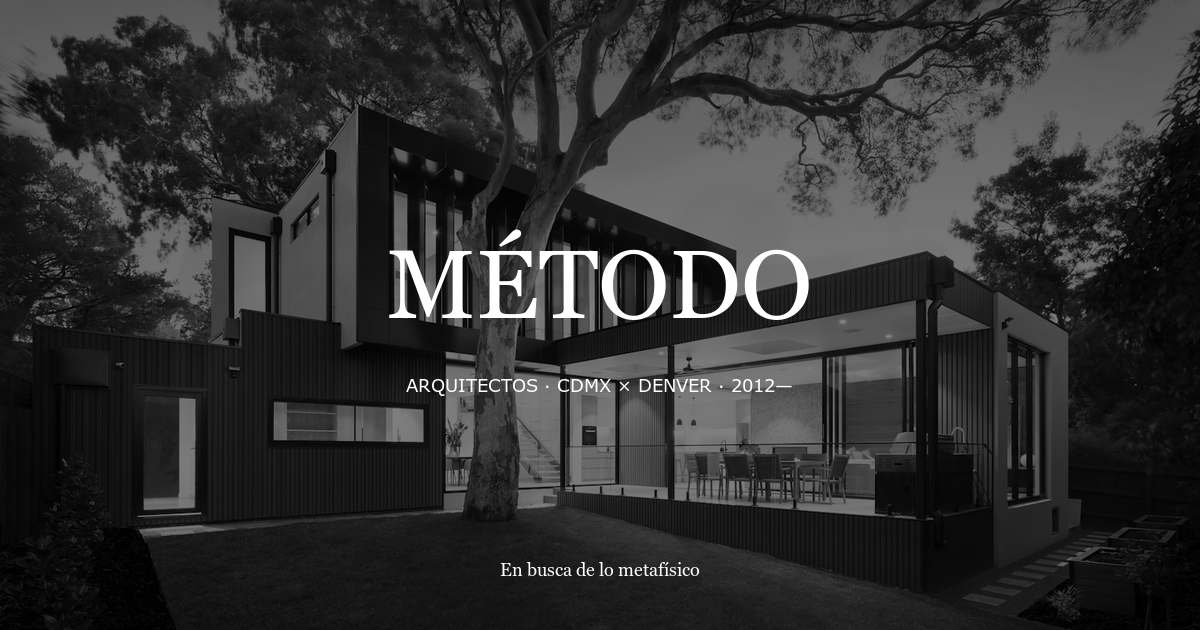
Concrete and stone in a Mexican boutique home are not a decorative palette chosen from a materials board. They are a response to climate, site, and what materials can honestly do in a specific location. In MÉTODO, the combination of concrete and stone begins with an inventory of what the site's region produces and what the climate demands.
Stone Sourcing and Regional Logic
Mexico is geologically diverse. The stone available for construction varies significantly by region, and that variation should shape the design.
In Oaxaca and the southern highlands, cantera verde — a soft volcanic stone with a distinctive green-gray tone — has been used in construction for centuries. It cuts easily, carves well, and weathers to a textured patina that no manufactured material replicates. It is also relatively porous, which means water management details at horizontal surfaces matter.
In Mexico City and the central highlands, chiluca limestone was the primary building stone of the colonial period. Its gray tone reads cleanly against concrete. It is denser than cantera and more resistant to pollution, which matters in an urban environment.
In coastal Jalisco and Nayarit, regional volcanic stone and basalt appear in vernacular construction. Basalt is very dense, extremely durable, and difficult to carve — best used as rubble fill, coursed wall stone, or rough-cut paving rather than fine masonry.
For a boutique home, we specify stone sourced from the region where the project is located. Piedra, madera y concreto: materiales que envejecen con dignidad — the stone that has always been in this landscape will continue to belong to it.
How Concrete and Stone Work Structurally Together
In contemporary Mexican residential construction, concrete provides the structural frame: columns, beams, slabs, and shear walls. Stone provides the infill: non-structural walls, paving, cladding, and water features. The two materials have different structural roles and different detailing requirements at their junctions.
A concrete column meeting a cantera stone wall requires a control joint to allow the concrete frame to move independently of the stone infill. Without it, cracks appear at the junction — not because either material failed, but because they move differently under thermal and seismic load. We draw these joints in the construction documents rather than leaving them to contractor judgment.
Stone paving on a concrete slab requires a mortar bed calibrated to the stone's thickness and the slab's moisture conditions. In coastal climates, a drainage layer under the mortar bed prevents trapped moisture from staining or lifting the stone. These are not complex details, but they need to be specified.
What "Boutique" Means in Design Terms
A boutique home is not a smaller luxury property. It is a building with high specificity: to its site, to its climate, and to the person who will live in it. The design decisions are not made from a catalog of available options. They are made from direct observation of the site and direct conversation with the client about how they want to inhabit the space.
In MÉTODO, a boutique project typically has a compact program — two to four bedrooms, with the primary spaces organized around a patio or courtyard rather than maximizing enclosed area. The investment goes into material quality, spatial precision, and construction detail rather than room count.
The matriz de opciones for a boutique home has fewer rooms to design but more decisions per square meter. The stone species, the concrete formwork pattern, the joint between interior and exterior paving, the window proportions in a 12-foot wall — each of these is resolved specifically for the project, not drawn from a previous project and adapted.
Thermal and Acoustic Properties
In a boutique home with concrete walls and stone floors, thermal behavior and acoustic behavior are the two performance variables that most affect daily life.
Stone floors in a climate with significant solar gain act as thermal mass: they absorb daytime heat and release it at night. This is useful in highland Mexico (Oaxaca, San Miguel, CDMX) where nights are cool and days are warm. In a tropical coastal climate with consistently high temperatures day and night, stone floors may absorb heat without releasing it effectively — a different response-climática is needed.
Acoustically, hard surfaces — concrete walls, stone floors — create reverberant spaces. A boutique home with these materials needs strategic soft elements: upholstered furniture, textile wall treatments in bedrooms, planted courtyards that absorb sound naturally. We specify these in the interior documentation, not as afterthoughts.
Próximos pasos
A boutique home with concrete and stone succeeds when the materials are chosen for the specific region, detailed for its climate, and combined with structural logic that acknowledges their different properties. The resulting building ages into its site rather than against it.
To discuss a boutique home project in Mexico, conoce el método de MÉTODO and tell us about your site.