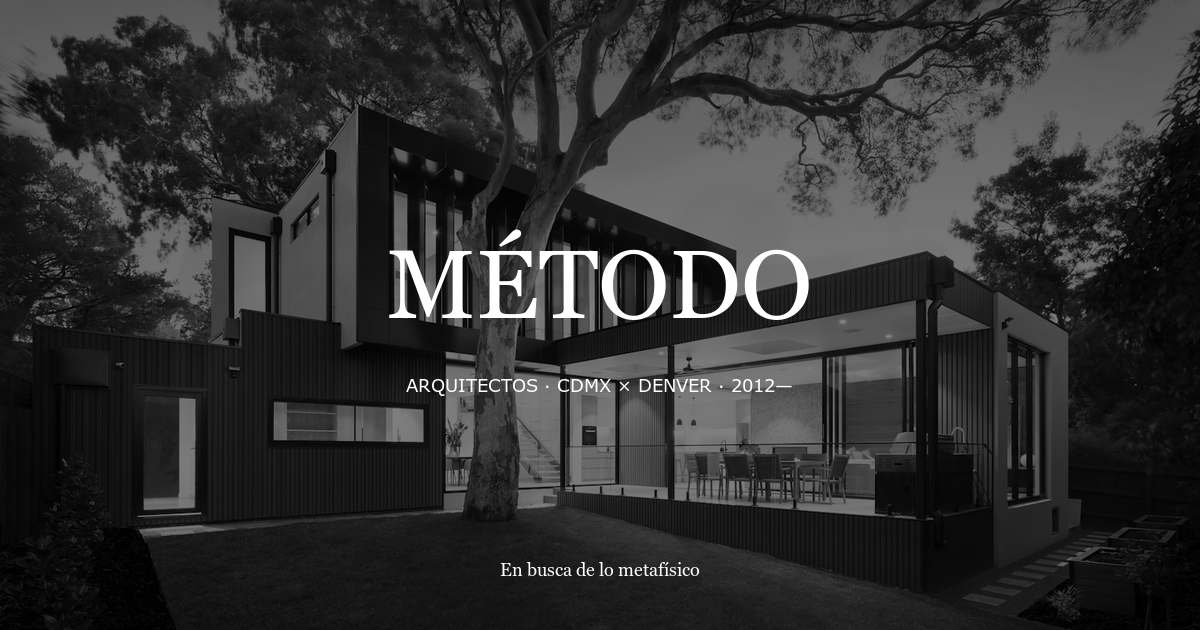
Boutique hospitality architecture in Mexico built with timber and stone succeeds when the building is as specific to its place as the landscape around it. A guest notices when the wall material came from the same hillside they are looking at; they notice when the timber ceiling spans are determined by the trees that were available, not by a standard lumber module. In MÉTODO, boutique hospitality is author architecture applied to a program that combines private and shared space in a specific landscape.
The Boutique Program: What It Requires
Boutique hospitality differs from large-scale hotel design in one fundamental way: every space is designed, not repeated. In a 200-room hotel, guest rooms are manufactured in a pattern. In a 12-room lodge, each room can have a different relationship to the landscape, a different ceiling height, a different material emphasis.
This creates a design challenge and an opportunity simultaneously. The challenge: more design decisions per square meter. The opportunity: a property where each room is genuinely different, and a guest can return and experience something they did not the first time.
In MÉTODO, boutique hospitality projects begin with a program that defines:
- Number and type of accommodations (suite, room, casita)
- Relationship between private (guest) and shared (dining, lounge, pool) zones
- Service circulation: how staff move without crossing guest paths
- Connection to landscape: which rooms have which views, which have private outdoor space
- Operational logic: how many staff are needed to run the property at full occupancy
The program is the contract between the owner's vision and the building's reality.
Timber Structure in Mexican Hospitality
Exposed timber structure in boutique hospitality conveys quality through what it requires to produce: a craftsperson who understands structural spans, species selection, and connection details. A hand-hewn parota beam spanning 8 meters across a dining room ceiling is not a decoration — it is structural timber, cut and placed by someone who knows the material.
In MÉTODO, timber structure in hospitality projects is specified with:
- Species selection matched to climate conditions: hardwoods in humid zones, pine in dry highland conditions
- Moisture content at installation: dried to equilibrium with the local climate to prevent movement after installation
- Connection details designed by the structural engineer and reviewed by the architect for visual consistency with the overall palette
- Finish specification: raw oil, penetrating sealant, or natural wax — never opaque paint that hides the material
Piedra, madera y concreto: materiales que envejecen con dignidad. In a hospitality context, this is an argument for return visits. Materials that improve with age — that develop patina rather than showing wear — give a property a living quality that manufactured finishes cannot replicate.
Stone in Hospitality: Interior and Exterior
Stone in boutique hospitality plays multiple roles simultaneously:
- Thermal mass: in highland climates, stone walls absorb day heat and release it at night, reducing heating loads and creating comfortable sleeping temperatures without mechanical systems
- Spatial identity: a stone entry floor from the local quarry is immediately specific to the place — it cannot be replicated in another location with the same material
- Durability: stone absorbs guest traffic without showing it in the way tile grout lines or wood floors do
In MÉTODO projects, we specify stone by quarry and by extraction batch where possible. Cantera stone varies in color and density across the same quarry; selecting from a consistent batch ensures the visual coherence of a floor or wall across the full property.
The transition between stone and timber is a recurring detail in boutique hospitality: where a stone floor meets a timber wall, or where a stone threshold meets a timber door frame. These details are designed in construction documents, not improvised on-site. The joint is the design.
Site and Landscape as Architecture
In boutique hospitality, the landscape is not the setting for the building — it is part of the program. A guest's experience of a property begins when they arrive and includes the sequence from arrival to guest room, the views from the dining terrace, and the relationship between their private outdoor space and the surrounding landscape.
In MÉTODO, landscape and site design are integrated into the architectural scope from the schematic phase. We do not design a building and then ask a landscape architect to fill in the exterior. The building and the landscape are one project.
Key decisions made in early design for hospitality landscapes:
- Arrival sequence: how a guest enters the property and is oriented to the whole
- View corridors: which sight lines are protected from guest rooms and which from shared spaces
- Outdoor social zones: covered terraces, uncovered terraces, pool placement relative to sun and privacy
- Service access: arrival of vehicles, waste removal, staff entry — separated from guest circulation
Próximos pasos
If you are developing a boutique hospitality property in Mexico — a lodge, small hotel, or retreat center — and want to work with an architect who treats it as a single authored project rather than a construction problem, the first step is a program and site consultation.
MÉTODO works on hospitality projects in Mexico City, highland states, and Pacific Coast locations. The process starts with the site and the program, not with a prototype.
Explore how MÉTODO approaches hospitality design — the process from site analysis to the first guest.